

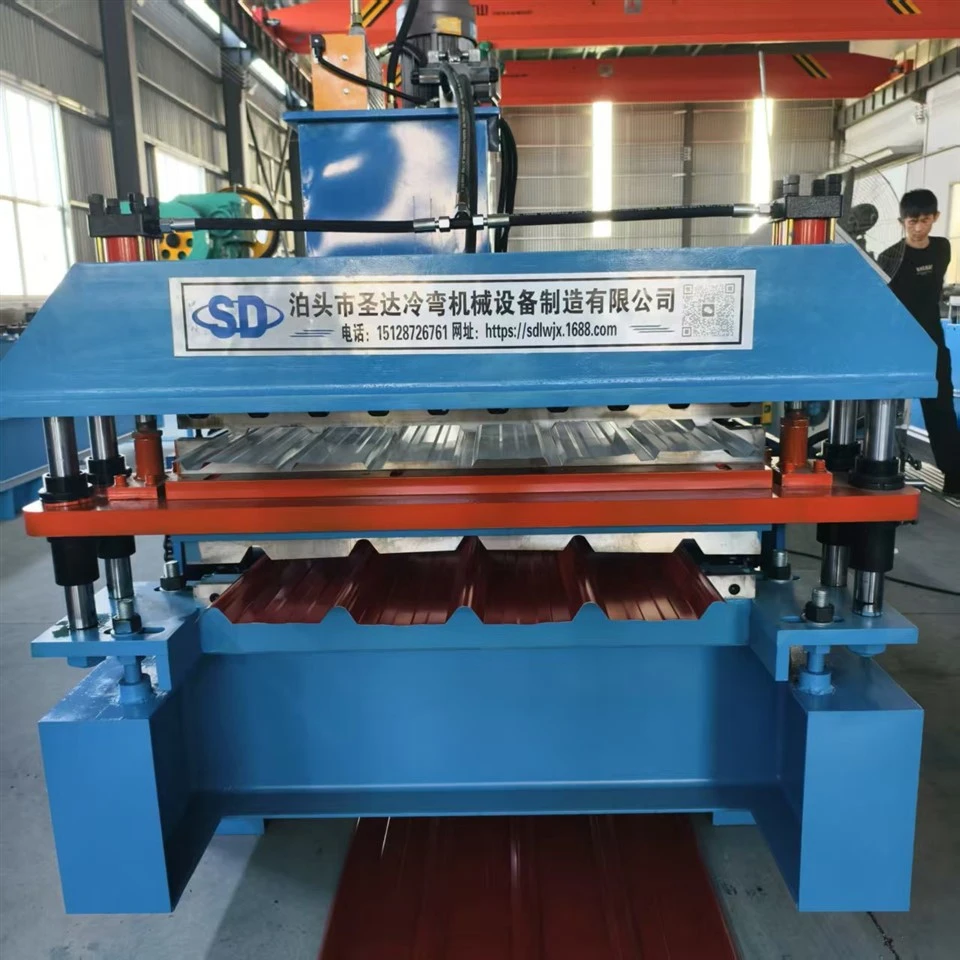
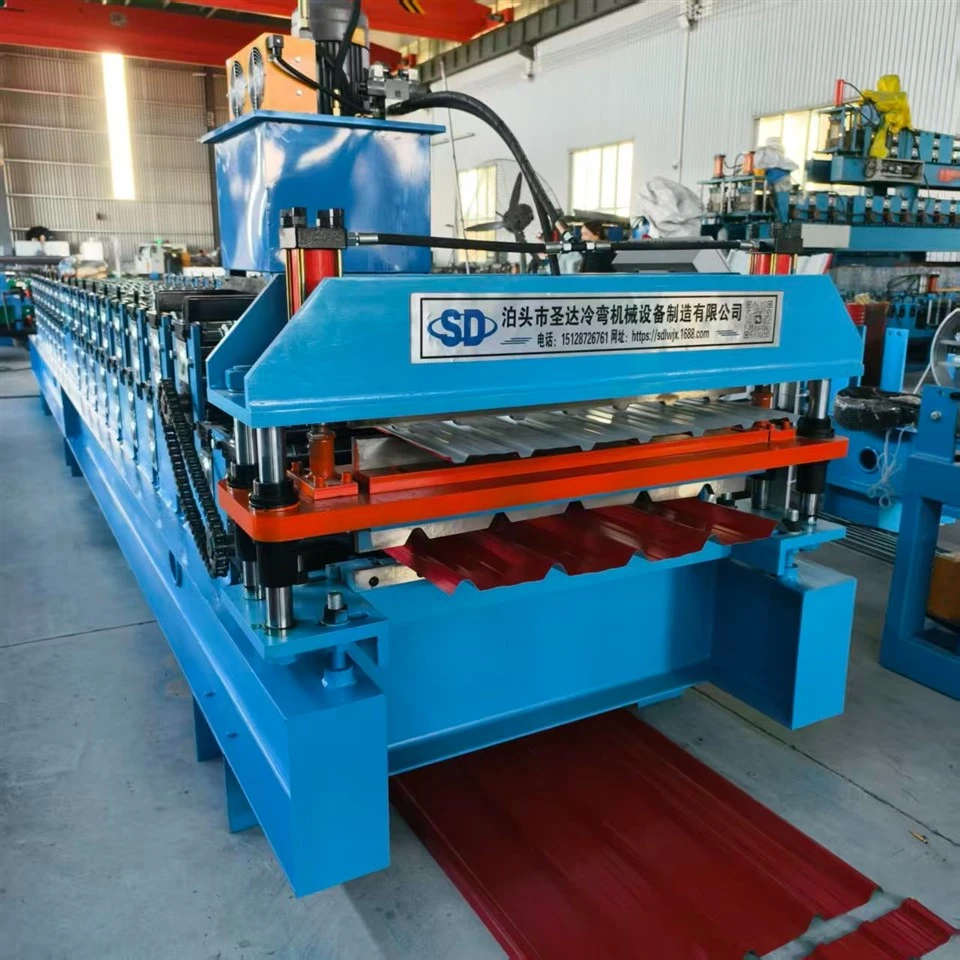
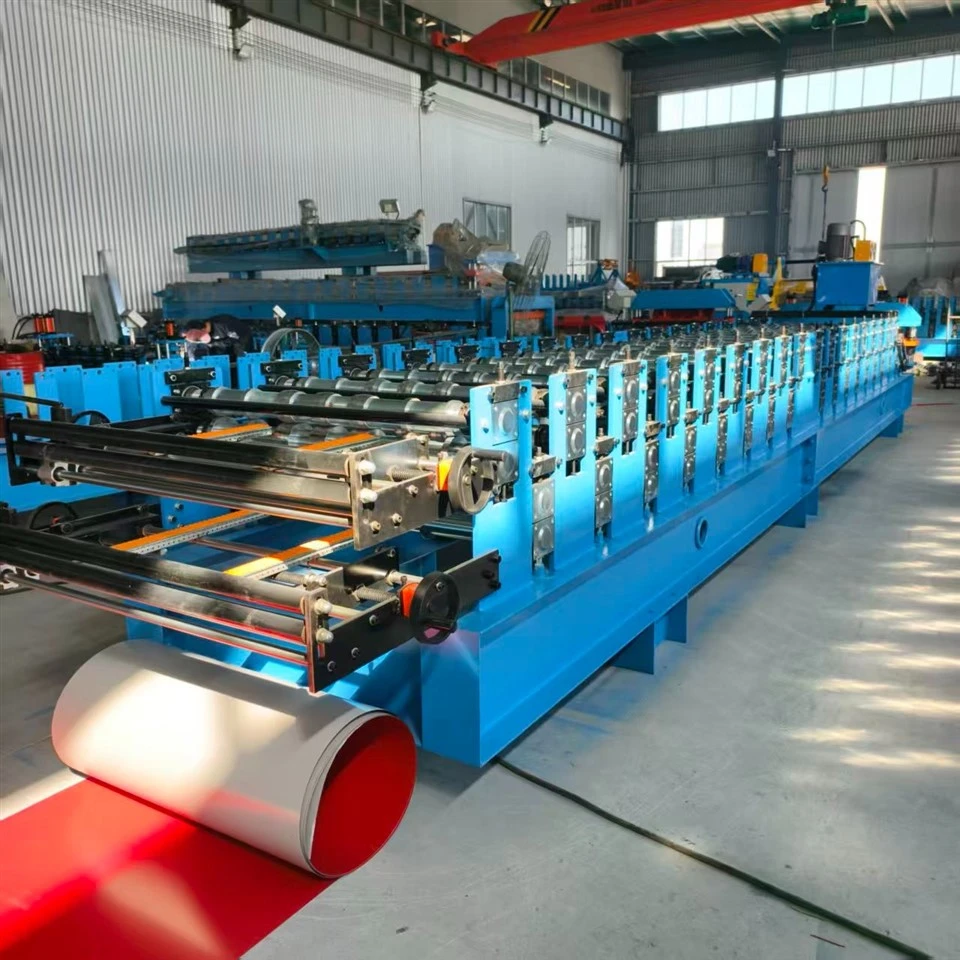
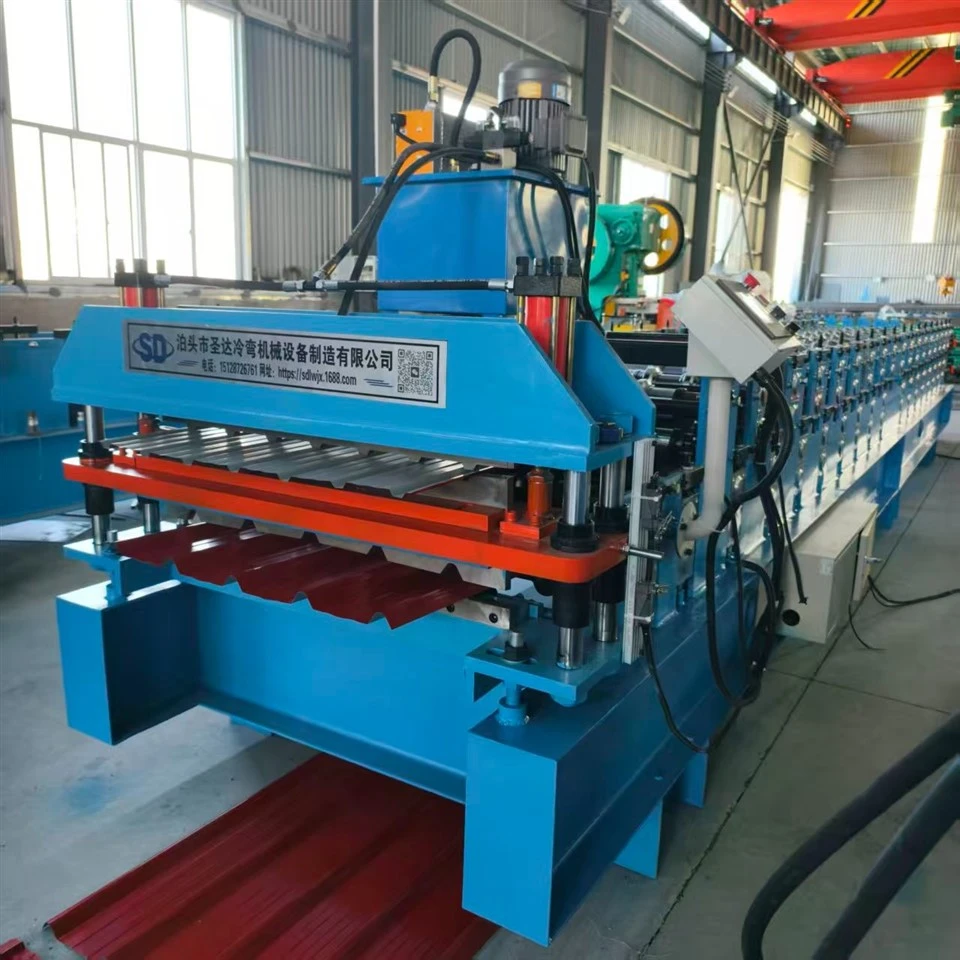
The 914 Roll Forming Machine forms 914 mm coil into a 762 mm cover-width panel in two profiles on one frame. Two independent forming stations are stacked on a single welded base and share one decoiler, one hydraulic station and one control cabinet. IBR / Spandek trapezoidal and corrugated are the two standard roll sets; other profiles, including glazed tile, are tooled from a drawing or a sample panel. Coil thickness range, line speed, drive arrangement and cut-off type are fixed in the order, because the roll set, the frame stiffness and the power pack all follow from them.
Structure and Working Sequence
Coil runs from the decoiler through the feed guide into the selected forming station, then to the cut-off and the run-out table. The lower station is the main line; the upper station is engaged only when its profile is being run, and the idle station is mechanically disengaged rather than left in contact with the strip.
The base is one welded frame, stress-relieved after welding and then machined so both stations mount to the same reference face. Each station carries its own shaft set, its own roll gap adjustment and its own drive connection, so setting one layer does not disturb the other.
Cut-off is either stop-and-cut with an encoder measuring length, or a flying shear that cuts on the move. Length and batch count are entered on the touchscreen, and the machine stops itself when the count is reached. The control cabinet carries the PLC, the touchscreen with one recipe per profile, the production counter and the fault display.
Product Advantages
914 mm coil in, 762 mm cover out
914 mm is a standard coil width in the sheet trade and 762 mm is the cover width the market laps. The 152 mm between them is not trim scrap: it becomes the two edge details, an upstand on each side plus the side lap that the following sheet covers. Frame and edge guides are set to the coil width stated in the order, so the width variation between mills is taken up at the guide instead of showing up as a walked strip at the forming station.
Two profiles from one set of ancillaries
One foundation, one decoiler, one hydraulic station, one control cabinet, one operator and one export crate serve both profiles. The second profile costs a roll set and part of the bay, not a second line. Long-run users specify two independent motors with separate VFDs so the idle station is genuinely stopped instead of spinning free, and vibration from one layer does not travel into the other.
Consistent rib height from a shared datum
Both stations are machined to one reference face, so an IBR panel from the lower station and a corrugated panel from the upper one are formed from the same datum. Each roller profile is checked against its profile template during machining, and shaft runout is measured on a dial indicator rather than by eye. On mixed orders, this is what keeps the junction between two panel types from showing a step.
Surface protection on the idle layer
The upper station sits above the working strip. Any roll still in contact with coated coil will mark it, so the idle layer is disengaged mechanically, not merely switched off at the control. Rollers are hardened, and the run-out table is set to take the panel clear of the cut-off before it is handled.
Profile Options
IBR / Spandek trapezoidal
762 mm cover, rib pitch set by the drawing - four pitches at 190.5 mm, five at 152.4 mm. Higher load capacity per millimetre of thickness than corrugated, full-rib side lap, used for roof and wall cladding on steel-framed buildings.
Corrugated
762 mm divides into exactly ten 76.2 mm (3 in) corrugations, matching the 3-inch closures, ridge cappings and washer-seat screws that roofers in Australia, the UK and Southeast Asia already stock. Cheaper to tool and easier to curve.
Glazed tile and accessory profiles. Tooled from drawing or sample panel on the same base frame, with the roll set matched to the layer it runs on.
Technical Parameters
|
Item |
Value |
|
Coil feed width |
914 mm nominal; frame and guides set to the coil width in the order |
|
Cover width |
762 mm - 152 mm absorbed by the two edge details |
|
Profile families |
IBR / Spandek trapezoidal, or corrugated; glazed tile on request |
|
Layer configuration |
Double layer - two independent forming stations on one welded base |
|
Coil thickness range |
Quoted per order; roll set ground for the range specified |
|
Line speed |
Quoted per order; set by profile, thickness and drive |
|
Drive |
Shared motor with clutch, or two independent motors with separate VFDs |
|
Cut-off |
Stop-and-cut with encoder, or flying shear; length and batch count on HMI |
|
Control |
PLC with touchscreen: one recipe per profile, counter, fault display |
|
Decoiler |
Manual or hydraulic; capacity quoted with the line |
|
Tooling |
One roll set per layer; custom profiles tooled from drawing or sample panel |
Applicable Markets and Scenarios
A feed width of 914 mm is quite common in export orders destined for Southeast Asia, Africa, and Australia; it is well-suited for producing building envelope materials such as colored steel roof tiles and wall panels. IBR trapezoidal profiles and corrugated profiles are frequently used for roofing and wall cladding on factory buildings, warehouses, sports facilities, and residential structures. A dual-layer roll-forming machine saves space and is an ideal choice for manufacturers who have limited floor space but wish to offer more than just a single type of panel profile.
Customization
Rollers are designed and manufactured based on provided drawings or physical samples, accounting for the effective cover width, corrugation geometry, stiffening ribs, and overlap edge details. Specifications such as material thickness range, uncoiler load capacity, cutting method, and power supply voltage must be determined at the time of order placement; electrical configurations must be finalized prior to the wiring of the electrical control cabinet.


FAQ
Q: Can the two layers run different profiles?
A: Yes, when both roll sets are ordered with the machine. Each layer is a separate forming station, so IBR can run below and corrugated above. A layer cannot change profile without changing its roll set, because the rolls are ground for one profile and one thickness range.
Q: What is supplied with the 914 Roll Forming Machine?
A: 914 Roll Forming Machine with both roll sets, the drawing set, the PLC program backup, the run-in sheet with the measured figures, one reference panel per layer marked with the serial number, and the spare parts list. Third-party inspection and video witnessing of the run-in can be arranged before shipment.
Hot Tags: 914 roll forming machine, China 914 roll forming machine manufacturers, suppliers, factory, 1080 1000 Roofing Sheet Roll Forming Machine, 1080 1000 Steel Roofing Roll Forming Machine, 914 Metal Roofing Roll Forming Equipment, 914 Steel Roofing Roll Forming Machine, double deck roll forming machine, double layer roofing sheet machine


