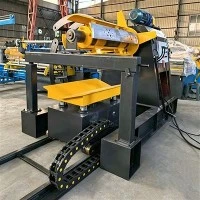
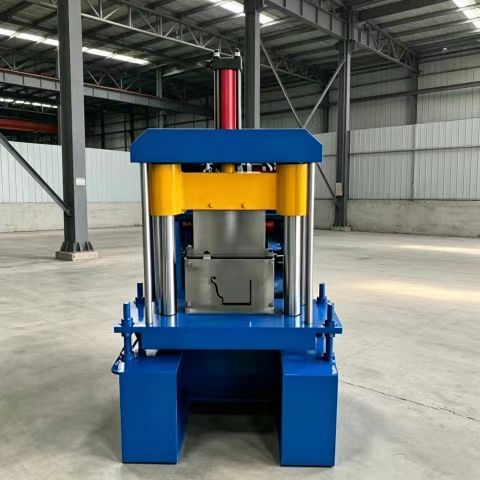
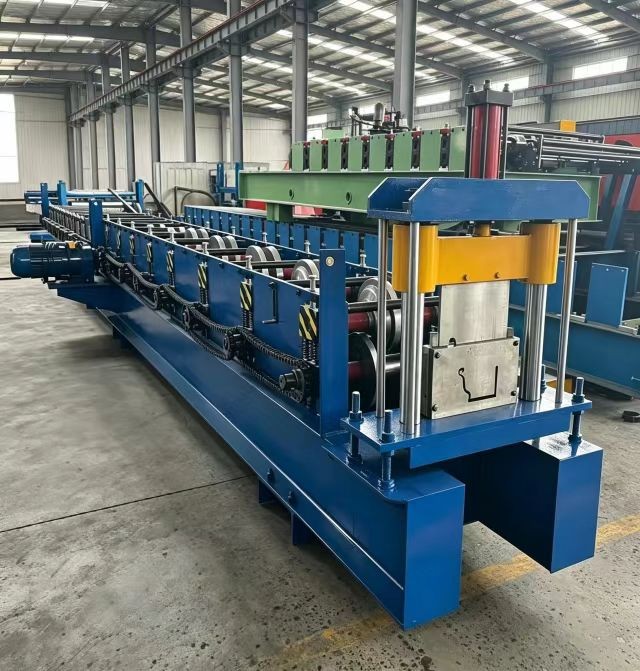
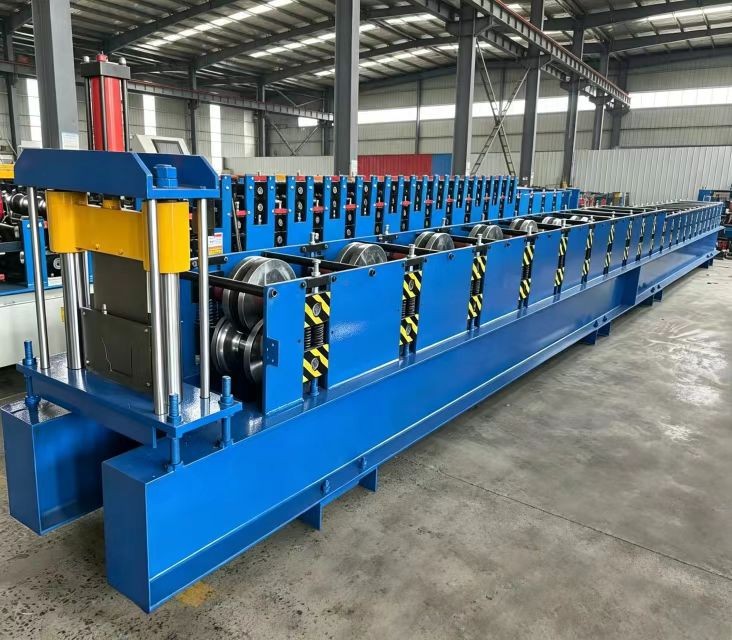
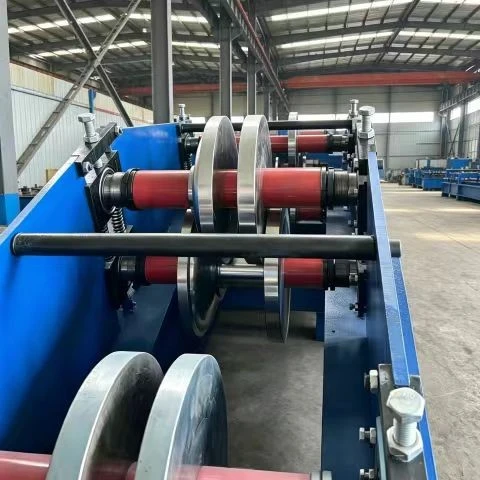
A gutter roll forming machine is specialized equipment designed for the continuous production of metal gutters. It typically consists of an uncoiler, a main roll-forming unit, a cut-to-length device, and a PLC-based control system with a touchscreen interface. The machine processes coiled materials-such as galvanized steel, pre-painted steel, or aluminum-through uncoiling, roll forming, and precise cutting to length. The profile shape and roller tooling can be customized based on customer drawings or samples. Specifications such as material thickness, production line speed, drive system (e.g., a shared motor with a clutch or dual independent motors with VFDs), and cutting method (e.g., stop-to-cut via encoder or flying shear) are configured according to individual orders. Through the HMI (Human-Machine Interface), operators can set parameters such as cut lengths, batch counts, and production recipes, as well as monitor system status and fault diagnostics. This equipment is ideal for the high-efficiency, batch production of drainage gutters used in construction.
Profile Range
Ogee and S-curve
The classic decorative gutter: an S-shaped face with a rolled bead at the top, used on villas, townhouses and heritage work. The S is what gives the eave a shadow line, which is the whole reason it sells over a plain channel.
01
Embossed patterns
A raised pattern - the Great Wall pattern is the one most often specified - rolled into the face of the section. It reads as carved cornice detail from the ground and it is the highest-value finish in the range, because the pattern is tooling rather than material.
02
Half-round and box sections
The simpler profiles for sunrooms, canopies, porch roofs and small commercial buildings, where the gutter is meant to disappear rather than decorate. Small Ogee and half-round gauges are the highest-volume request from sunroom and awning installers.
03
Large-capacity sections
Wider and deeper gutters for factories, warehouses, greenhouses and photovoltaic roofs, where the catchment area per metre of gutter is many times that of a house roof and the rainfall intensity in the region sets the size.
04
Custom sections
Any profile supplied as a drawing or a sample length is tooled from that, including the return edge detail and the bead radius.
05
Technical Parameters
|
Item |
Value |
|
Raw material |
PPGI colour steel, GI galvanized steel, aluminium |
|
Coil thickness |
0.3–0.8 mm, quoted per profile and section depth |
|
Line speed |
8–15 m/min, set by profile and thickness |
|
Forming stations |
Single layer, close-pitch train; stand count set by section depth |
|
Embossing |
In-line station ahead of the forming train, pattern tooled to order |
|
Rollers |
45# carbon steel, chrome plated and polished on the bead rolls |
|
Drive |
Chain transmission |
|
Cut-off |
Hydraulic guide-post shear, cut length set on the touchscreen |
|
Control |
PLC with touchscreen, Chinese and English interface, one recipe per profile |
|
Supply includes |
Decoiler, sheet support frame, run-out table |
|
Customization |
Section, size, material, thickness and embossing pattern tooled to customer drawing |
Product Advantages
Pre-embossing: Patterns are embossed before the final forming stage. This ensures the top beaded edge remains intact (without collapsing) and the bottom hem is formed cleanly (without distortion). If embossing were performed after forming, the already-shaped beaded edge would likely be flattened.
Beaded edge radius: Defined by the final forming station and maintained by a polishing roller. This ensures consistency from the first meter of the coil to the last, preventing water from easily spilling over the beaded edge.
Inward-folded hem: The cut edge is folded inward, eliminating sharp edges where water could otherwise collect and trigger corrosion.
Close-coupled forming stations: Designed to securely grip deep, thin-gauge profiles, minimizing twisting and tracking errors. Entry guides prevent the strip from rubbing against roller flanges, thereby protecting the coated surface.
Cut-to-length based on actual eave dimensions: Lengths are entered via a touchscreen, with automatic batch counting. This results in fewer joints, improved sealing, and a reduced need for rework.
Applications
High-end villas, detached houses and townhouses
The mainstream market, European, American, Mediterranean and Victorian revival elevations, where the gutter is part of the cornice. An S-profile with an embossed face carries the highest premium, because it replaces a plain channel with a line that reads as architectural detail.
Light-steel villas and prefab houses
Overseas prefab and modular builders fit gutters as part of the roof package, in colour steel or aluminium to match a metal roof. These orders are repeatable and standardised, which suits a line with a fixed roll set and a recipe per house type.
Sunrooms, canopies and porch roofs
Small ogee and half-round gauges, short lengths, frequent pattern of order. Installers in this segment buy by the metre and care about how fast a length can be produced and how clean the cut is.
Small commercial buildings
Clubs, guesthouses, shops, hotels, showrooms and town commercial streets, where the facade is the product and the eave line is part of it.
oFactories, warehouses, greenhouses and photovoltaic roofs
Large sections for high rainfall intensity and long roof runs, including the drainage detail around PV arrays, where a blocked or undersized gutter backs water onto the roof and under the mounting system.
Heritage restoration
Reproduction of classical cornice profiles for old-building repair, where the section has to match an existing eave rather than a catalogue.
Customization and Service
Sections are tooled to the customer's drawing or a sample length, including the bead radius, the return edge, the face height and the embossing pattern. Material and thickness are fixed at order, because they decide the roll set and the stand count.
Every machine is run before packing. Plate and shaft certificates are filed against the serial number, frame diagonals are checked for square, and a coil at the ordered thickness is run through the line. The first lengths are checked against the profile template for face height, bead radius and cut length, and the figures go onto the run-in sheet. A sample length is marked with the serial number and shipped as a reference, together with the drawing set and the spare parts list.
Installation, alignment, commissioning and operator training are provided, with remote support afterwards. The spare parts list names the first wear items - the bead rolls and the shear blade take the most punishment on a gutter line - with their part numbers.

FAQ
Q: Should the embossing process in a Gutter Roll Forming Machine take place before or after the forming stage?
A: It should be done before forming. By embossing the pattern into the flat sheet before it enters the forming stands, you ensure that the top bead remains intact and the bottom hem (return edge) stays clean. If you emboss after forming, the already-shaped bead is likely to be flattened.
Q: Why is the hem (return edge) folded inward on a Gutter Roll Forming Machine?
A: Folding the cut edge inward eliminates sharp edges where water could otherwise collect and trigger corrosion; if the cut edge were left exposed, water would tend to cling to that line.
Q: How should the drive and cutting systems for a Gutter Roll Forming Machine be selected?
A: For the drive system, you can choose a shared motor with a clutch or dual independent motors paired with separate VFDs. For the cutting system, options include stop-cutting (triggered by an encoder) or flying-cut systems. The specific configuration-including length and batch settings managed via the HMI-should be determined based on the profile type, material thickness, and required production capacity.
Hot Tags: gutter roll forming machine, China gutter roll forming machine manufacturers, suppliers, factory, 840 Roofing Sheet Roll Forming Machine, Individual Panel Roll Forming Machine, metal roofing sheet roll forming machine, single panel roofing roll forming machine, single sheet roll forming machine, Trapezoidal Roof Roll Forming Machine