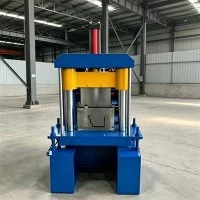

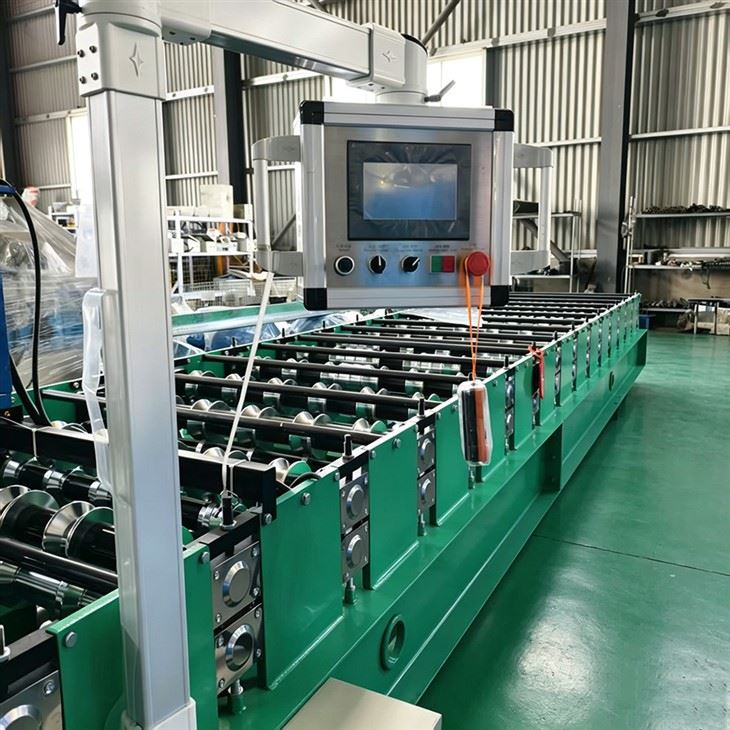
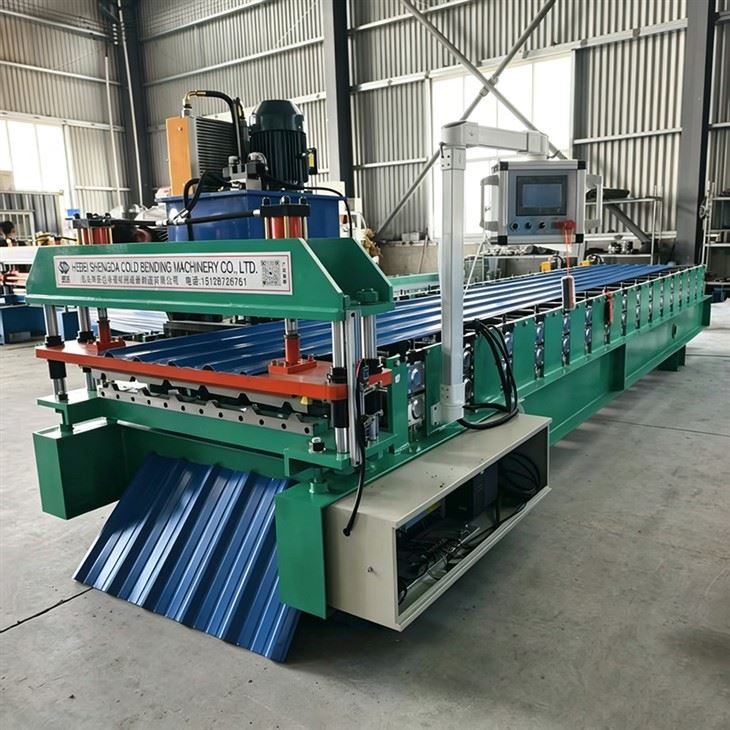
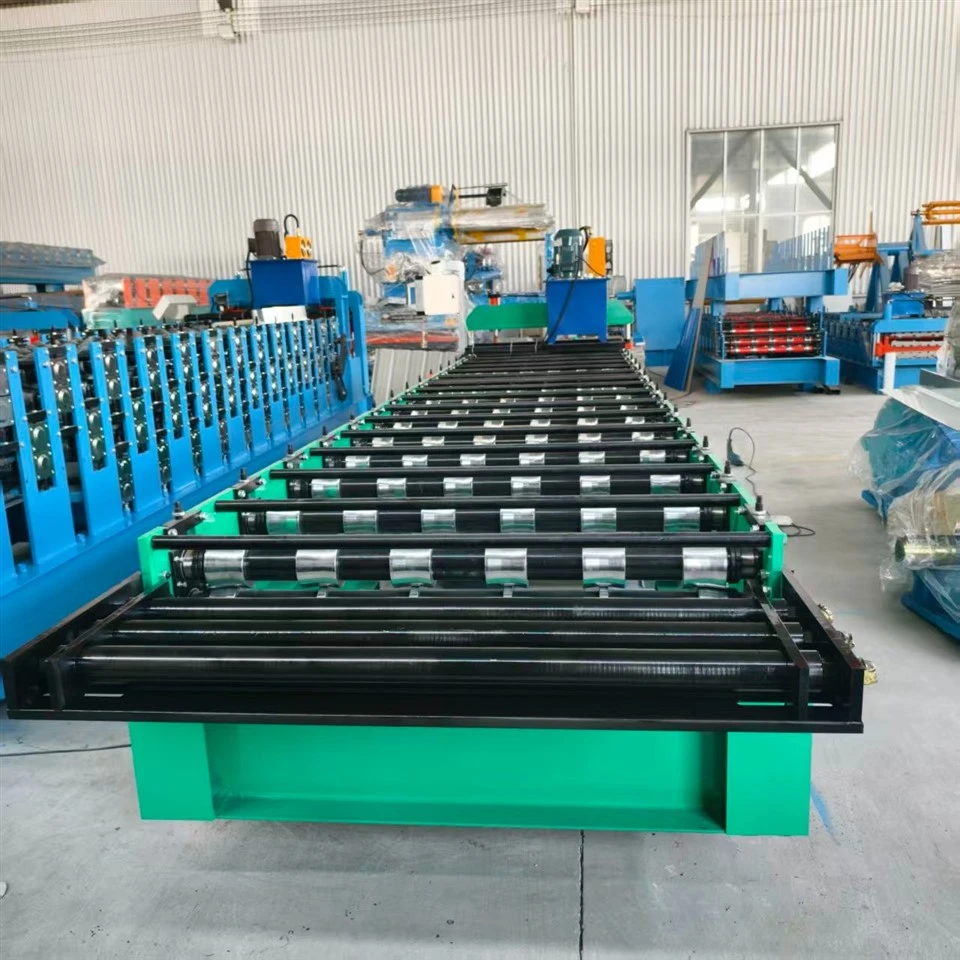
The Single Layer Roll Forming Machine carries one forming station, one roll set, and it makes one profile. There is no second forming level, no changeover mechanism, no shaft shared between products: what stands on the floor is a welded frame, one shaft set, one drive, one shear and one control cabinet, arranged so that a single panel can be produced all day without touching a setting.
Structure and Working Sequence
Coil is loaded on the decoiler, fed through the guide into the forming station, formed progressively on one shaft set, cut to length by the hydraulic guide-post shear, and delivered onto the run-out table.
The frame is a welded structure with machined mounting faces for the station, sized for continuous production rather than for occasional use. Because it carries one station, the frame under the working load is short and heavily sectioned, which is what holds the profile stable over a long run.
The shear is a hydraulic guide-post type: the blade travels on guided posts on a fixed path instead of swinging on an arm, so the cut stays square at the end of a long panel. Cut length and batch count are entered on the PLC touchscreen, and the line trips the shear at length and stops at count.
The drive is a chain transmission - the economic arrangement, and the one that is easiest to service in a plant without a machine shop. Tension and lubrication are the two maintenance items that decide how long a chain drive stays accurate, and both are accessible from the operator side without removing the guard frame.
Standard Coil Platforms
|
Platform |
Feed width |
Typical profile |
Cover width |
Main market |
|
CIS trapezoidal |
1250 mm |
C8, C10, C20, C21 |
1000 mm |
Central Asia, Russia, CIS |
|
Standard 840 |
1000 mm |
Trapezoidal 840 |
840 mm |
Southeast Asia, South Africa, Australia |
|
Wide |
1200 mm |
Per profile drawing |
Per profile drawing |
Quoted per order |
|
Factory panel |
900 mm |
T44, T57 |
Per profile drawing |
Kazakhstan industrial buildings |
The 1250 mm platform is the volume seller in Central Asia, Russia and the CIS, where C8, C10, C20 and C21 trapezoidal sheets at 1000 mm cover are the standard wall and roof panel. The 1000 mm platform producing an 840 mm cover is the equivalent standard in Southeast Asia, South Africa and Australia. The 900 mm platform is built for the T44 and T57 sections used on industrial buildings in Kazakhstan
Technical Parameters
|
Item |
Value |
|
Raw material |
PPGI color steel, GI galvanized steel, aluminum |
|
Coil thickness |
0.3–0.8 mm |
|
Line speed |
8–15 m/min |
|
Forming stations |
Single layer - one station, one roll set |
|
Rollers |
45# carbon steel, chrome plated; additional stands recommended for high-strength coil |
|
Drive |
Chain transmission |
|
Cut-off |
Hydraulic guide-post shear; cut length set on the touchscreen |
|
Control |
PLC with touchscreen, Chinese and English interface, automatic cut-to-length |
|
Supply includes |
Decoiler, sheet support frame, run-out table |
|
Profile change |
Not possible on the same roll set - a different profile needs a different machine or a multi-layer machine |
Product Advantages
Simple structure, few failure points
One station, one shaft set, one drive, one shear. No second forming level, clutch, or changeover mechanism. All failure-prone parts are on one level, reachable from the floor, so faults are found by inspection, not sequence-tracing. When the nearest technician is a day away, that difference shows up in uptime.
01
Stable forming on a profile that does not change
A single-layer machine grinds its roll set for one profile and one thickness range. Side guides are set once, gaps stay put, and there is no compromise between profiles or re-set to re-check. Strip wandering has nowhere to start. The panel repeats from the first sheet of the coil to the last.
02
Lower price than a double layer line
If your volume sits in one profile, the double-layer premium buys a second station that idles most of its life. Put that money into a heavier frame, more forming stands, or a second machine for the second profile. A second machine also keeps one breakdown from stopping both products at once.
03
One profile per machine, and that is the point
No changeover procedure, no setup card per profile, no fitter who knows two roll trains. Maintenance is a known parts list-a replacement roller, bearing or chain comes off one drawing. If you run two profiles, buy two machines or a multi-layer machine, not a single-layer machine plus a second roll set. The changeover, not the roll set, is where money and scrap go.
04


FAQ
Q: Can one Single Layer Roll Forming Machine make more than one profile?
A: No. A single layer machine carries one roll set, and the roll set is ground for one profile. Changing the panel means changing the roll set and re-setting every stand - a day of work, a second roll set in storage, and scrap on the first sheets after each change. A buyer who needs two profiles should look at a double or triple layer machine, where each profile has its own station.
Q: Can Single Layer Roll Forming Machine run high-strength steel?
A: Yes, with more forming stands. High-strength coil does not pull down to the profile in the same number of passes as mild steel, and forcing it through a short roll train produces edge wave and springback at the last stand. Adding stands is the correct change; increasing shear tonnage does not fix a forming problem.
Q: What is supplied with the machine?
A: The line with its roll set, the decoiler, the sheet support frame, the run-out table, the PLC cabinet with Chinese and English interface, the drawing set, the run-in sheet with the measured figures, one reference panel marked with the serial number, and the spare parts list.
Hot Tags: single layer roll forming machine, China single layer roll forming machine manufacturers, suppliers, factory, 840 Roofing Sheet Roll Forming Machine, Individual Panel Roll Forming Machine, metal roof panel making machine, single panel roofing roll forming machine, single sheet roll forming machine, Trapezoidal Roof Roll Forming Machine